

Words by Jenny Lynn Davis | Images by Al Blanton
For nearly four decades, Roger Hill kept a black box sealed shut in the back of his mind.
Inside it were the jungles of Vietnam, the ambushes and artillery, the men he loved and the men he lost, the fear that stuck to his boots like red clay mud. He didn’t talk about it. Not to his wife. Not to his friends. Not to anyone.
Then one day, he started to write.
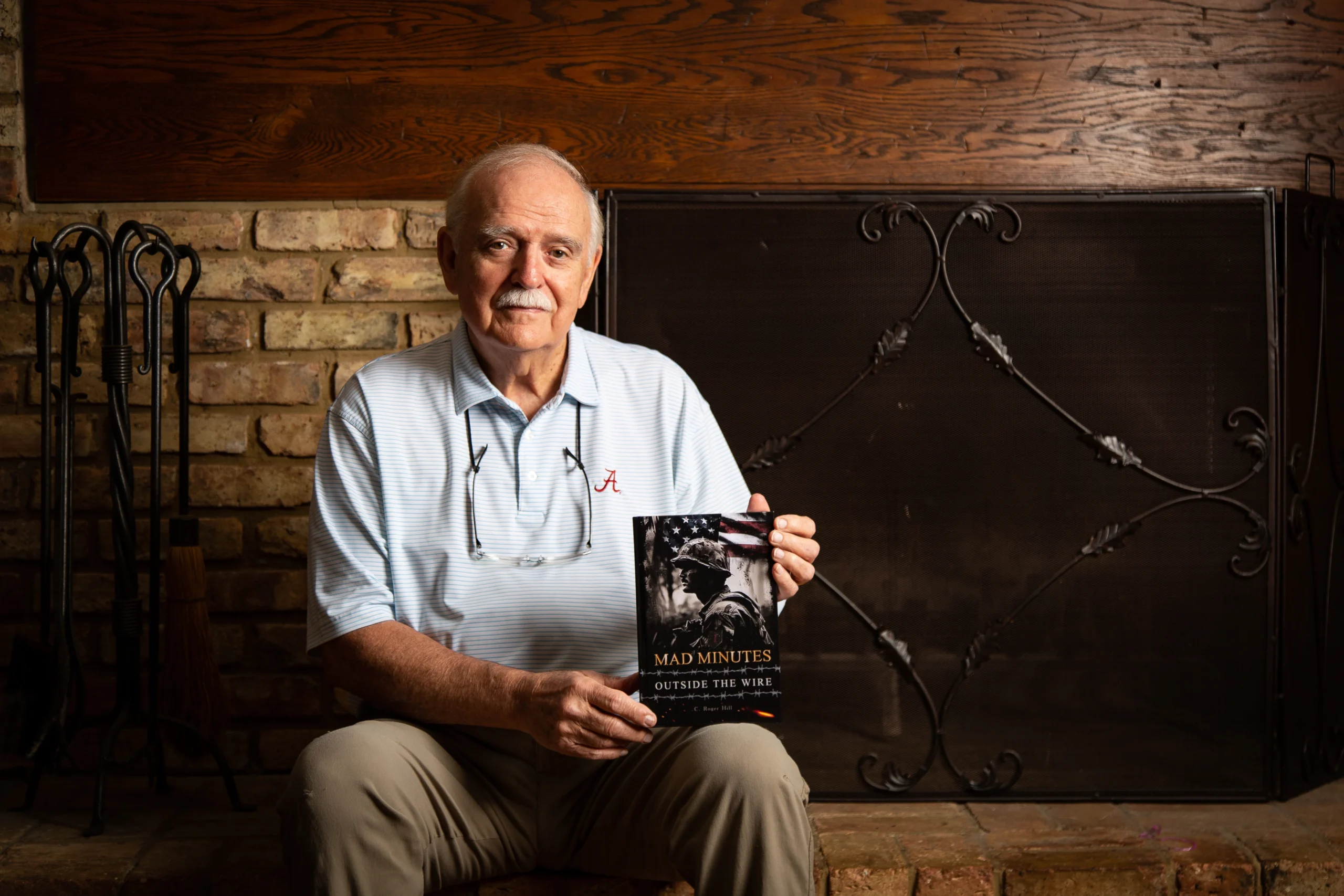
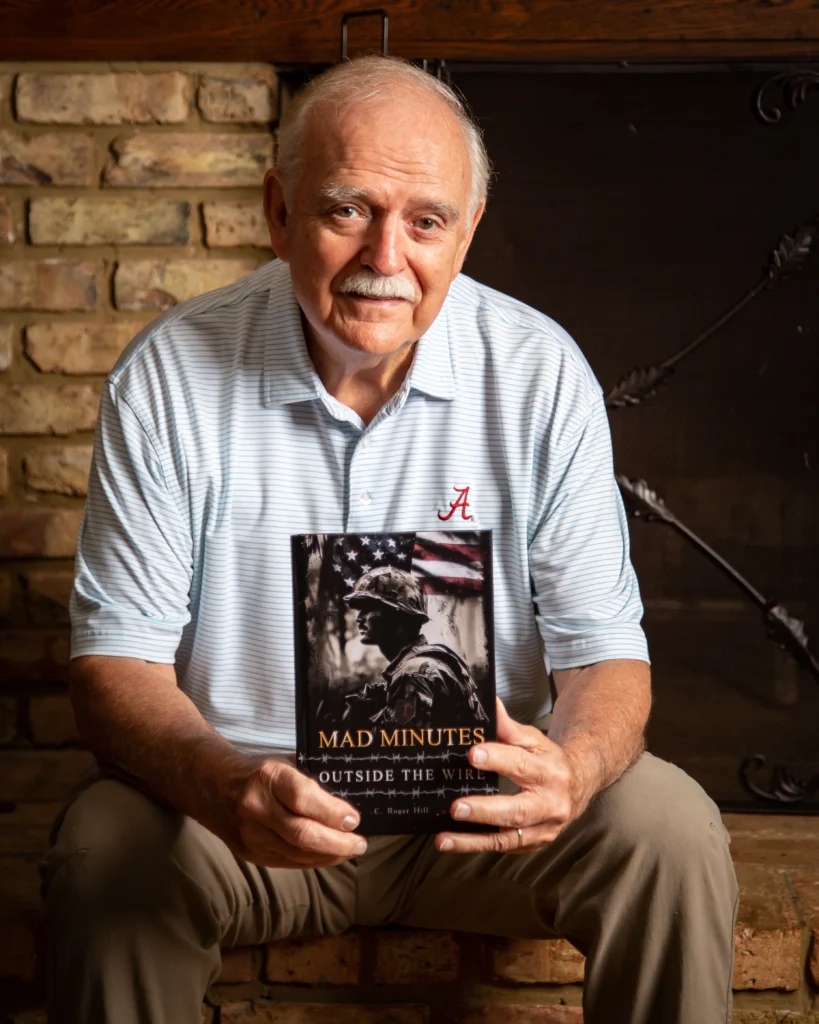
The result is Mad Minutes Outside the Wire, Hill’s first-person account of his service with the U.S. Army’s 1st Infantry Division in Vietnam from 1968 to 1969. Part memoir, part history lesson, and part long-overdue tribute to the men who fought beside him, the book has quietly found its audience since publication, reaching the top five in Vietnam biographies on Amazon and drawing readers from as far away as Australia.
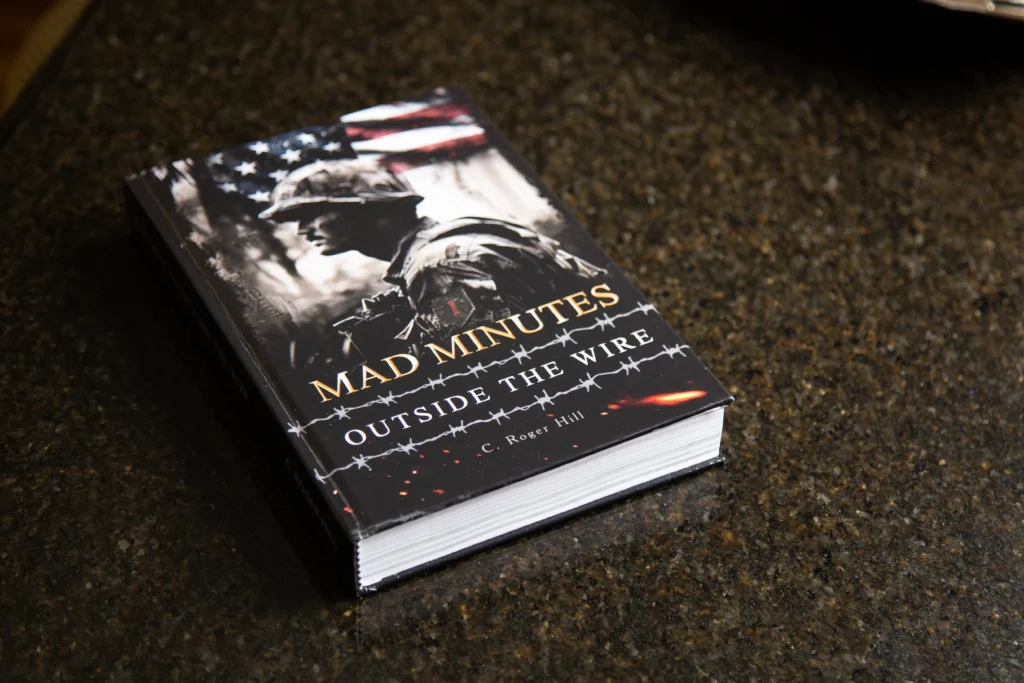
Hill, who grew up in Jasper and still calls it home today, didn’t set out to write a bestseller. He set out to survive.
“I call it digital therapy. I needed to get that stuff out of me,” he says.
The need had been there for years, but the words came slowly. It took fifteen years to complete the book, not because Hill lacked material, but because the material was heavy. He would write in bursts, then stop, then start again. A student interview for a Birmingham-Southern College class assignment cracked something open. When Hill answered the questions, he filled a hundred pages without meaning to. Dan Scarborough, who received a copy of those pages through his son, called Hill and told him plainly: this had to go somewhere.
“I said, ‘Well, everybody needs to know about my people, my men.’”
That became the true north of the project. Before the book was about battles, politics, or history, it was about names. About 19 members of Hill’s company were killed in Vietnam. Perhaps another hundred were wounded. Hill served as a squad leader, responsible for twelve men whose lives were, in many ways, extensions of his own.
“Those 12 men were my 12 men,” he says. “My squad was my family, and I took care of them.”
Among those men was Dave Gaarder, his lieutenant, who was killed in battle. Hill spent months tracking down Gaarder’s family before writing that section of the book, wanting their blessing before committing the story to the page. Gaarder’s brother told Hill that no one had ever called them.
“He said, ‘We know now what happened, but nobody ever called us,’” Hill recalls. “I would have thought someone would have contacted them.”
There was also Arron Smith, “Smitty,” from Baton Rouge, Louisiana. There was Gary Floyd Garrett, his radio telephone operator from Mobile, whom Hill describes as “a good guy.” There was Steve Holden from Scranton, Pennsylvania, who took shrapnel in his face and nearly lost a leg in a firefight Hill describes as one of the most intense of the war.
Hill tracked Holden down decades later to make sure the details in his manuscript were correct. When Hill finally reached him and explained who he was, Holden said, “I can’t talk,” and hung up.
Holden called back a week later to reveal he had cancer and was at Vanderbilt’s treatment center. Soon after, the two spent a whole day together. Holden had been carrying a fifty-year-old question: had the lieutenant tried to crawl back before he died?
Hill chose his answer carefully. “He did try to get back to us before he died,” he told Holden. He didn’t tell him the rest.
“That was 50 years later,” Hill says quietly, “and he was still struggling with it.”
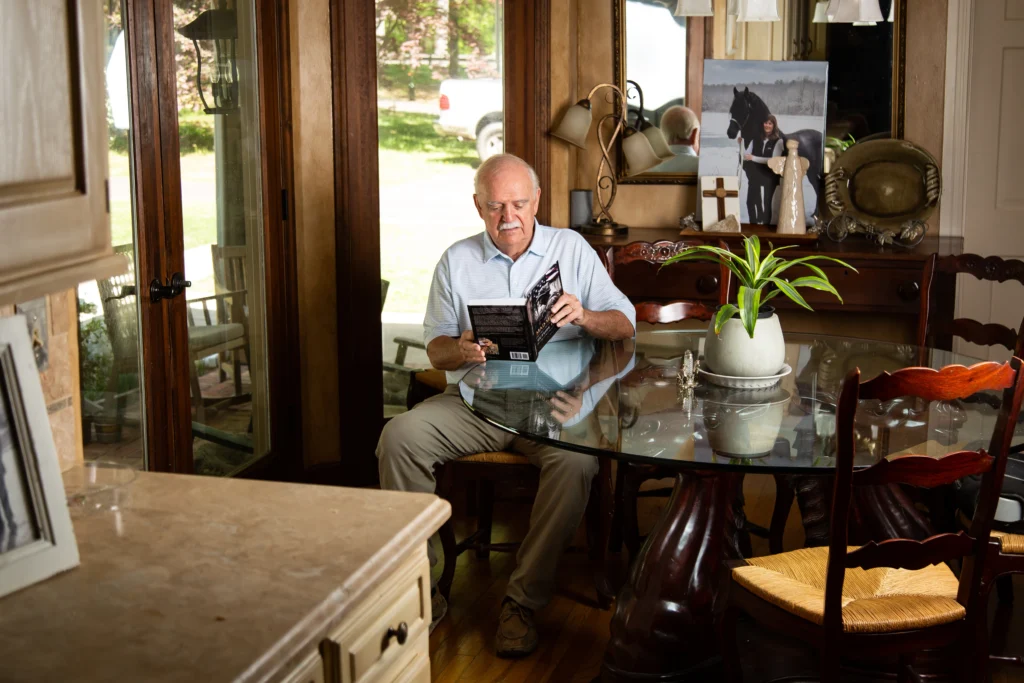
Those are the kinds of memories Hill carries in the book, not as distant recollections, but as moments still close enough to touch.
One of the book’s distinctive qualities is how it is organized. Rather than conventional chapters, Hill uses what he calls “episodes,” self-contained moments from the war, each with its own arc. The structure, he explains, mirrors how war actually feels: a mission happens, it ends, and then something else begins. Some of those episodes are almost unbearable in their precision.
One, “Raining Friendly Artillery,” recounts the nightmare of friendly fire when an inexperienced forward observer accidentally called an artillery strike on his own men. Hill lay flat on a sandy trail as the first shell exploded in the trees. Something told him to roll. He rolled behind a tree. A piece of shrapnel, still smoking and green with yellow American markings, stabbed into the ground right where he’d been lying. Seven men were wounded. His lieutenant told him that night that a soldier named Dean Oltman had died, killed by their own artillery.
Episode Three, which Hill says some readers find hardest to put down, covers his first real experience of close combat and the first time he saw Americans killed in direct, face-to-face fighting.
“I struggled with it for about a month,” he says of writing it. “I was scared to death after I saw that.”
Hill did not want to flatten those scenes into simple combat stories. He wanted readers to understand what the men saw, heard, feared, and survived. He spent months working to do the scenes justice, consulting F-4 Phantom pilots to get the technical details of bombing runs right, wanting to put the reader “right in the cockpit” with the pilot.
“Instead of just writing ‘an F-4 came in,’” he says, “I went and found the guys who flew them and asked them everything.”
The result is a memoir that moves with the urgency of combat, but Hill is careful not to let the war begin and end in Vietnam. For him, some of the deepest wounds came after he left.
If the combat was brutal, the homecoming was its own kind of wound. Hill describes walking into the San Francisco airport in his dress uniform, a new set issued to him before departure, adorned with his CIB, two Bronze Stars, and two Presidential Unit Citations. Within minutes, four people were spitting at him and trying to fight. Strangers at the bar waved him over. “These guys have been doing that to every soldier that comes through here,” they told him.
He thought maybe it was just San Francisco, but back in Tuscaloosa, it wasn’t any different.
“People hated us because they called us baby killers,” he says. “I was isolated. I was by myself, working at night and going to the University of Alabama. I had a little room by myself and nobody to talk to about it.”
Hill had been in Vietnam the whole time with no newspapers or television. He didn’t know what the protests looked like or how deep the hostility ran.
“We didn’t know the days of the week,” he says. “We just thought we were heroes. I really thought I was a hero. I was a patriot.”
So, he went quiet. For years after, Hill didn’t tell people he had served. He describes finally deciding to step out of what he calls “the veterans’ closet,” going public with his service, as one of the most significant decisions of his later life, and says that writing the book completed that process.
“It cured my anxieties completely,” he says. “I can talk about it now.”
Before that, even twenty years after the war, he says he would begin to speak and his hands would sweat, his stomach would turn. But Hill does not view Mad Minutes Outside the Wire only as a personal release. He also sees it as a record, one he hopes can help readers understand a war that many now know only in fragments.
He spends considerable space explaining the political and strategic context of the war, including the domino theory, the roles of Kennedy and Johnson, and the question of whether sustained bombing could have brought North Vietnam to the table.
That combination of personal memory and historical context has resonated with readers. Since its release, Mad Minutes Outside the Wire has seen tremendous success globally and locally as well. Hill pushed a copy into the hands of the Jasper Public Library, and they soon bought four more. All five were checked out almost immediately. The library hosted a book signing that drew a hundred people; Hill’s wife sold out their entire stock of 85 copies.
Hill’s neighbor, who had just returned from touring modern Vietnam, read the book through the night and finished it at four in the morning. She couldn’t put it down.
Hill thinks especially about young readers, the people who are now roughly the age he was when he was drafted. The average soldier in his company was 22 years old and the average education level was 14.5 years of schooling.
“I hope people get a basic understanding of the Vietnam War and what we were doing there,” Hill says. “If kids don’t know about the war, they need to read it. If they do know about the war, they need to read it. I think they’ll have a whole different perspective.”

Hill worked closely with Skip Tucker, a longtime newspaper editor and friend from his post-Vietnam years, who served as principal editor and wrote the foreword. Two other editors, including a certified editor from the Northwest Alabamian, helped shepherd the manuscript into its final form. Hill’s son Brandon also served as an editor, responsible for framing the layout of the book, developing the cover of the book, and coordinating publishing.
Even now, Hill remains modest about what he has accomplished, almost to a fault.
“I’m sort of embarrassed about writing it, because I know there are Vietnam vets that served much more perilous tours than my men and I, but take from this what you will, each veteran has his own story,” he says. “It was written to honor those infantry veterans in Delta Company, 1st Battalion of the 2nd Infantry Brigade, First Infantry Division Republic of Vietnam 1968-1969.”
After keeping the black box shut for nearly forty years, Hill has finally opened it, and what came out was not only his own story, but theirs too. WL
Mad Minutes Outside the Wire is available at madminutesbook.com and through Amazon, where it has ranked in the top echelons of Vietnam War biography and military memoir. An audiobook version is in development.